The role of banks in financial health
Banks are part of people's daily lives. They manage savings, support new businesses and make major life decisions possible. Yet many Europeans still lack the financial knowledge to handle these moments with confidence. When that gap stays open, financial inequality persists, opportunity gaps widen and communities become less resilient.
National banking associations carry most of this work. Each one understands its own regulatory and educational context, and designs and delivers financial education programmes through its own networks. The EBF adds a European layer. It organises initiatives such as the European Money Quiz final and campaigns during European Money Week, and it builds on what its members already do so that financial education across Europe becomes more coherent, more ambitious and more useful to the people it serves.

Our objectives
Through the Financial Education Projects Group (FEPG), the EBF and its members share one vision: a Europe where financial education is not a privilege but a foundation for life.
- Reach people at every stage of life. Most activity today focuses on young people. There is significant room to do more for early-career professionals, families, older adults and groups at greater risk of being left behind.
- Link learning to real decisions. Financial education works best when it connects to the choices people actually face. That means saving and investing, taking on a mortgage or debt, planning for retirement and protecting themselves against fraud.
- Help members learn from each other. The EBF connects expertise across borders and tracks progress through the Financial Literacy Playbook. The Playbook documents financial education in every member country and shows where it has improved, where gaps remain and which new priorities are emerging.
- Bring the sector's experience to European policy. The EBF shares what its members have learned with EU institutions and contributes to European and international work on financial literacy.
Financial Education At The EBF
The EBF has been promoting financial education via various means, including several publications and initiatives on financial literacy highlighting the industry commitment to providing consumers with a more sound understanding of financial services.
The EBF is an affiliate member of the OECD International Network on Financial Education
European Platform For Financial Education
In February 2017, a group of nine European organisations and associations launched a new European Platform for Financial Education. The initiative aims to promote the need for financial education and to boost financial literacy in Europe, particularly among young people and entrepreneurs. It also seeks to encourage EU-level leadership in this field.
The platform’s founding partners are, in alphabetical order: Better Finance; CFA Institute; EUROCHAMBRES; European Banking Federation (EBF); European Banking & Financial Services Training Association (EBTN); European Fund and Asset Management Association (EFAMA); European Microfinance Network (EMN); Insurance Europe; and JA Europe.
The partners have agreed to pool their strengths to advance financial literacy in Europe. The platform serves to exchange ideas, information, insights and experiences, as well as to facilitate discussions on how the European Union can play a leading role in advancing financial literacy. The platform will also help the partners coordinate their involvement in European-level initiatives to develop potential synergies and to avoid duplication of work. Read more
Why finantial education matters
As citizens face increasingly complex financial choices, from digital banking and investment opportunities to retirement planning and protection against fraud, the ability to manage money effectively has become essential. Yet financial literacy gaps persist across Europe, affecting vulnerable populations and constraining economic opportunity.
Sustainable financial literacy requires collaboration between the banking industry, policymakers, regulators, educators and civil society. When citizens understand financial systems and feel confident in their financial decisions, they build stronger personal security, contribute more effectively to the economy, and support the stability and inclusion of the broader financial system.


EBF Financial Literacy Playbook For Europe
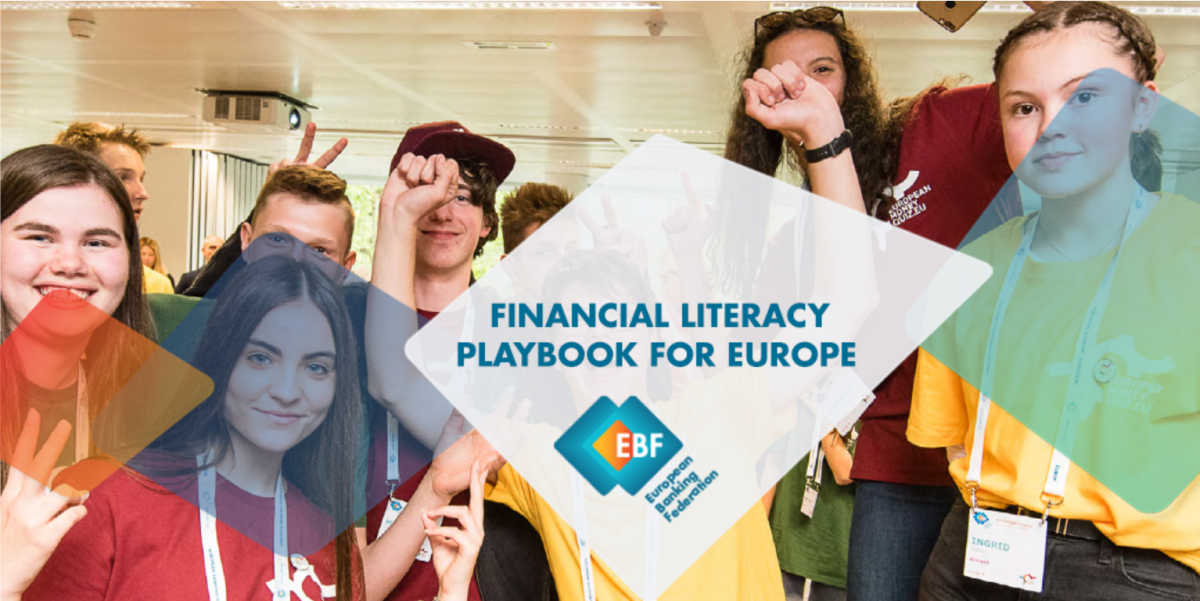
The EBF published on November 3, 2020 a Playbook in which readers can explore what the banking sector – together with governments and leading NGOs – does to boost financial education and financial literacy. It provides a valuable snapshot of the banking industry’s financial education initiatives across 35 countries in Europe and can be used as a country-by-country reference guide.
 We are passionate about financial education. Young people must learn at an early stage how to manage their finances if they want to be successful in life. To promote the benefits of financial education and to raise awareness we, together with our members, organise European Money Week.
 Learn about the initiative and put yourself to the text! Could you beat the European champions? Practice in your own language and find out how to register for the next European Money Quiz!








Related news & insights
Questions about this topic?
We are happy to help.